




How Epic Eliminated $17 Million in Costs and Transformed Education Logistics with Automation

In Brief
Automated Warehouse System: EWOCS, Drives $17 million in Annual Savings
Epic Charter Schools faced rising costs, poor service, and operational delays in managing critical student learning assets through a third-party vendor. As a trusted, long-term technology partner, Resource Data worked closely with Epic to design and implement the new Epic Warehouse Operations Control System (EWOCS), an automated warehouse and logistics system.
Working with Resource Data, Epic saved $17 million in annual operational costs by replacing the third-party vendor with the EWOCS automation warehouse system. The new system also reduced annual shipping costs by $1.5 million, improved delivery times from weeks to just two business days, and reduced warehouse staffing by 50% with automated workflows while simultaneously tripling order volume.
Key Takeaways
Cutting Costs by $17 million and Improving Logistics for Education Systems
-
$17M Annual Cost Savings from Vendor Replacement
By replacing a third-party vendor with an automated, in-house system, Epic reduced operating costs from $20 million to $3 million, saving $17 million in annual costs.
-
80% Reduction in Shipping Costs
Selecting EasyPost as a shipping vendor and leveraging pre-negotiated carrier rates reduced shipping costs from $1.5 million to $300K, $1.2 million less.
-
3x Increase in Order Volume with 50% Less Staff
Automation enabled Epic to triple order volume while reducing warehouse staffing by 50%. Automated shipping workflows generate labels instantly, allowing staff to simply print and apply labels, eliminating manual steps, and accelerating fulfillment.
-
Faster Delivery Improves Student Access and Funding Stability
Delivery times improved from weeks to days, ensuring students receive learning equipment and devices such as Mifi routers quickly. This allows students to remain engaged and attend classes, while protecting Epics federal funding tied to student participation and attendance.
-
End-to-End Automation Reduces Manual Work and Errors
EWOCS automates order processing, inventory selection, shipping, and asset tracking, reducing manual effort and improving accuracy across operations.

Epic Charter School
Epic Charter Schools is a large-scale, charter school education provider supporting over 24,000+ students through distributed learning. Each year, Epic manages over 180,000 technology assets – including MiFi routers for monthly home internet access, Chromebooks, calculators, and docking stations, and processes over 33,897 student orders through its Learning Fund platform. These assets, including digital assets, are essential to enabling student participation, especially for students without internet at home; this maintains Epics’ federal funding.
Resource Data has served as a long-term technology partner to Epic, collaborating not only on improving software solutions but also on business process improvements. This close partnership enabled proactive identification of inefficiencies and the opportunity to modernize Epic’s assets and logistics operations in-house.

The Challenge
Costly Delays and Shipment Inefficiencies Threaten Student Access to Learning and Supplies
Epic Charter Schools relied on a third-party vendor to manage asset inventory, warehousing, and shipping for critical student learning equipment. Over time, this model became unsustainable due to high costs, poor service, and limited responsiveness. Epic spent approximately $20 million annually on vendor services, plus $1.5 million on shipping. At the same time, they faced significant data quality issues, with nearly 190,000 assets requiring “cleanup” due to inaccuracies or duplicates.
These inefficiencies had direct business and student impacts. Delivery times extended up to five weeks, limiting students from learning or participating in classes as a result of no quick access to learning supplies, directly putting Epic’s federal funding at risk. Delays affected hundreds of students, and Epic faced losses around federal funding. These challenges created risk of financial loss, reduced efficiency, and ongoing disruption to the student learning experience.

Our Approach
12-System Integration Layered on an Accelerated Timeline
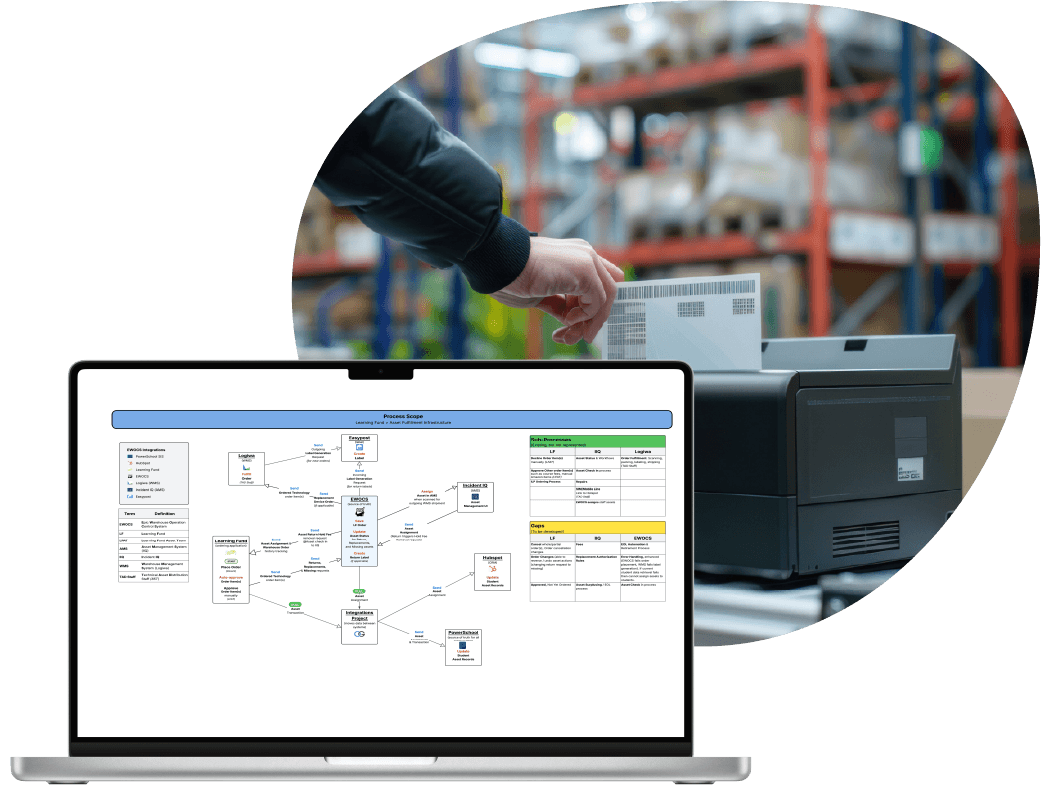
Resource Data worked closely with Epic to evaluate their existing vendor model and define a path toward a more efficient, internally managed solution. Rather than building a traditional application, the team designed the system as a backend integration layer—connecting 12 systems and orchestrating automated workflows without a user-facing interface.
Due to the early termination of the vendor contract, the solution had to be delivered on an accelerated timeline. The team focused on core features, deciding what needed to launch, and what could be refined later. Using a mix of custom integrations and selected commercial tools, we delivered a scalable solution quickly and reduced disruption to students’ academics.
The Solution
An Automated Integrated Logistic System: Epic Warehouse Operations Control System (EWOCS)
To replace a costly and inefficient vendor model, Resource Data implemented the Epic Warehouse Operations Control System (EWOCS). This integrated logistics solution and warehouse management system automates and streamlines asset management, inventory control, warehouse operations, and order fulfillment end-to-end. Instead of a single application, EWOCS is a backend ecosystem of multiple systems, APIs, and automated workflows, allowing data to move seamlessly across platforms.
EWOCS connects multiple platforms such as Incident IQ, Learning Fund (student purchase platform built by Resource Data), Logiwa, EasyPost, PowerSchool, and Epic’s internal systems. As part of the solution, Resource Data helped Epic select EasyPost, the shipping platform, and negotiated low carrier rates and built-in compliance capabilities. This reduced shipping costs, simplified label generation, and eliminated the need to build complex shipping logic in-house, accelerating implementation and improving overall operational efficiency.
Features
System Automation Scales 3x Growth in Order Volume
-
Orders Process Automatically from Start to Finish
Student orders placed through the Learning Fund automatically trigger EWOCS workflows, initiating fulfillment without manual input. The system processes orders, assigns inventory, prepares shipments, reduces errors, and speeds up delivery.
-
The Right Devices and Accessories Are Automatically Selected for Orders
EWOCS automatically selects and packages the correct matching accessories, such as chargers and docking stations based on the device chosen and predefined rules. This ensures accuracy while removing guesswork for warehouse staff.
-
Shipping Labels are created for instant ship off
EWOCS sends order details to EasyPost to generate compliant shipping labels with optimized carrier rates. Warehouse staff simply print and apply labels, saving time, and simplifying the process.
-
Warehouse Staff Only Pick, Pack, and Ship
Orders arrive fully prepared, with inventory selected, packing decisions made, and labels ready to print. Staff only need to pick, pack, and ship, reducing effort and enabling the team to handle significantly higher order volumes.
-
Every Asset Is Automatically Tracked from Order to Return
EWOCS automatically tracks each device throughout its lifecycle, from when it is assigned to a student to when it is returned or retired. This ensures accurate records without manual updates and gives Epic full visibility where every asset is at any time.
-
Returns Are Simple for Students
EWOCS automates return label generation and the asset return process. Students receive a QR code that can be scanned by USPS, allowing carriers to handle labeling, cost, and processing. This process makes it easy for students to return devices like MiFi’s and Chromebooks without requiring any additional steps.


Epic is the land of acronyms; we use to have a lengthy sheet for new hires that was essentially an acronym dictionary. I am a huge nerd, especially about Star Wars. The starting two letters for the system were “EW” and I intentionally forced the last 3 letters to at least sound like “EWOKS”. I couldn’t make the “K” work. Resource Data was also a critical partner. We would not have been able to build the product without them. Their expertise and guidance were critical in crafting the best possible product.
- Chana Goodno, Epic Product Owner of EWOCS

Results
$17M Savings, 80% Lower Shipping Costs, 3x Growth
EWOCS delivered major financial and operational improvements for Epic Charter Schools. Epic reduced annual operating costs from approximately $20 million to $3 million, saving $17 million annually from day one. Shipping costs also dropped from $1.5 million to $300,000 through the selection of EasyPost and negotiations for low carrier rates.
Operational efficiency improved significantly. Epic reduced warehouse staffing by 50% while tripling order volume and processing tens of thousands of shipments annually. Delivery times dropped from weeks to only 2-3 days, ensuring students receive devices quickly and protecting the risk of federal funding loss tied to attendance.

What's Next
A Mature System Built for Ongoing Performance
Over the past two years, Resource Data and Epic refined EWOCS through improvements in data quality, process efficiency, and shipping workflows, including hazmat compliance. Today, EWOCS is a mature, stable system operating on a scale. Resource Data continues to support EWOCS with ongoing updates and enhancements to ensure reliable performance and continued operational efficiency.



Case Study FAQ
The only reliable way to ensure fast delivery at scale is to remove manual handoffs from the fulfillment process and replace them with an automated, system driven workflow that begins as soon as a student request is approved. Instead of staff reviewing orders, checking inventory, and coordinating shipping step by step, the system orchestrates those actions instantly.
In practice, this means connecting the student ordering system (such as a learning fund or request portal) directly to inventory, asset management, and shipping platforms. When a request is submitted, the system automatically selects the correct device, assigns it to the student, generates a shipping label, and updates tracking records across all systems. This eliminates the delays that typically occur when orders sit in queues waiting for manual processing.
The Epic case study illustrates this shift clearly. Prior to automation, delivery timelines stretched into weeks because of vendor dependency and manual coordination. After implementing the EWOCS platform, fulfillment became near immediate, reducing delivery times to just a few days. That change wasn’t just operational; it directly affected whether students could access learning, participate, and stay engaged.
In distributed learning environments, logistics is inseparable from instruction. When access to devices and connectivity is delayed, participation drops, support tickets rise, and administrative teams are forced into reactive troubleshooting instead of proactive support.
This shift typically becomes viable when three conditions converge: logistics costs are disproportionately high, workflows are repetitive and predictable enough to automate, and the organization needs more visibility and control than a vendor can provide.
Third party logistics providers are often optimized for general purpose fulfillment, not education specific workflows such as student eligibility, device assignment rules, or asset tracking tied to enrollment. Over time, this mismatch creates inefficiencies, processing delays, lack of real time visibility, and limited ability to adapt workflows to changing educational needs.
In the Epic case, the tipping point was financial and operational. Outsourcing logistics costs roughly $20 million annually, while still producing slow delivery and limited control. By bringing operations in house and automating the core workflows, Epic reduced costs dramatically while gaining the ability to adapt processes, integrate systems, and scale operations more effectively.
However, this is not simply a “build vs buy” decision. It requires confidence in integration capability, internal process ownership, and the ability to manage logistics as a core function. Many organizations underestimate the importance of the integration layer; the real value comes not from the warehouse itself, but from how seamlessly systems communicate and coordinate.
The key is to treat these systems not as separate tools, but as components in a single workflow orchestrated through a shared integration layer. APIs act as the connective tissue, enabling systems to exchange data in real time rather than relying on batch updates or manual entry.
Instead of entering the same information into multiple systems, each action triggers the next automatically. A student order updates the SIS record, assigns inventory in the warehouse system, generates a shipping label, and creates an asset record, all without human intervention. Each system remains specialized, but together they function as one coordinated environment.
In the Resource Data implementation, EWOCS connected 12 systems, including PowerSchool, Logiwa, EasyPost, and internal tools. This allowed Epic to eliminate redundant data entry and reduce the risk of inconsistencies between systems.
Without this level of integration, organizations often experience “data drift,” where different systems show conflicting information. That leads to lost devices, shipping errors, and time consuming reconciliation efforts that slow down operations and increase costs.
Reducing shipping costs at scale requires treating shipping as a strategic scalability, not just a transactional step. This means optimizing carrier selection, automating rate comparison, and eliminating inefficiencies in how orders are processed and packaged.
A major source of cost inefficiency is manual decision making, choosing carriers, generating labels, and managing shipments individually. By integrating a shipping API, organizations can automatically select the most cost effective carrier and service level for each order, based on weight, destination, and delivery requirements.
In the Epic case, implementing EasyPost allowed the organization to negotiate better rates and automate carrier selection. This reduced annual shipping costs from $1.5 million to $300,000, demonstrating how much inefficiency can exist in unmanaged shipping workflows.
Cost reduction also comes from consistent, automated workflows. When workflows are automated, errors like duplicate shipments, incorrect packaging, or expedited shipping due to delays are significantly reduced.
Effective tracking requires a lifecycle based system where each device is treated as a continuously managed asset rather than a one time transaction. This means assigning a persistent identity to each device and linking it to students, orders, and system events throughout their lifespan.
The challenge is not just tracking location but maintaining a reliable history of status changes: who the device is assigned to, when it was shipped, whether it was returned, and its condition over time. This requires integration between asset management, help desk systems, warehouse tools, and student data systems.
In the Epic case, nearly 190,000 assets were cleaned and brought into a unified tracking system. EWOCS ensured that every device movement from assignment to shipment, to return was recorded and synchronized across systems.
Without lifecycle tracking, organizations quickly lose visibility. Devices go missing, duplicate purchases occur, and support teams lack the information needed to resolve issues efficiently.
When asset records are unreliable, the entire logistics and support system begin to degrade. Staff cannot confidently assign devices, troubleshoot issues, or recover assets, leading to cascading inefficiencies.
Inaccurate data often results from fragmented systems, manual entry, and lack of synchronization. Over time, discrepancies accumulate; devices appear in inventory but are actually deployed or are assigned to the wrong student.
Epic faced this exact issue, with tens of thousands of assets requiring cleanup. By automating data synchronization and standardizing records across systems, they restored confidence in their data and enabled accurate decision making.
Reliable data is not just a technical requirement; it is an operational foundation. Without it, even well designed workflows fail because they rely on incorrect assumptions.
In distributed learning environments, access to devices and connectivity is directly tied to whether a student can participate. Delays in delivery translate into missed instruction time, reduced engagement, and increased risk of disengagement.
Because participation and attendance are often tied to funding and performance metrics, logistics delays can have financial consequences beyond operational inconvenience. Students who cannot access their devices are effectively excluded from the learning environment until the issue is resolved.
The Epic case study demonstrates how reducing delivery time from weeks to days can significantly improve participation. Faster fulfillment ensures students can begin learning immediately, reducing the likelihood of drop off and improving overall program stability.
This is one of the clearest examples of how operational systems directly influence educational outcomes. Logistics is not a back office function; it is part of the learning infrastructure.
Automation increases capacity by removing repetitive, time consuming tasks from human workflows. Instead of staff manually processing each order, the system handles intake, validation, inventory selection, and shipping preparation automatically.
This allows staff to focus on exceptions, issues that require judgment or intervention, rather than routine repetitive tasks. As order volume increases, the system absorbs the additional load without requiring proportional increases in staffing.
In the Epic implementation, this shift enabled the organization to triple order volume while reducing warehouse staff by half. This demonstrates how automation changes the relationship between workload and labor requirements. The deeper advantage is consistency. Automated systems perform tasks the same way every time, reducing variability and improving overall reliability.
Simplifying returns is critical because families often lack the tools or time to navigate complex return processes. Requiring printers, packaging decisions, or multiple steps to introduce friction that leads to delayed or incomplete returns.
Automated return systems remove these barriers by generating preconfigured labels and enabling QR code based returns. Families can simply bring the device to a carrier location, where the code is scanned, and the label is generated on site.
In the Epic case, this approach made it significantly easier for students to return devices, improving recovery rates, and reducing asset loss.
This also reduces administrative burden. Instead of coordinating returns manually, the system handles the process, allowing staff to focus on tracking and exceptions.
The decision should be based on long term alignment with operational needs, rather than short term cost. Key factors include cost structure, control over workflows, ability to integrate systems, scalability, and risk tolerance.
Outsourcing provides simplicity but limits flexibility and visibility. Insourcing offers control and potential cost savings but requires investment in systems and expertise. Hybrid models attempt to balance these factors, often using internal systems for core workflows and external partners for overflow or specialized tasks.
Epic’s shift to an in house model highlights the advantages of control and scalability when supported by automation. However, not all organizations need to fully insource, many benefit from phased or hybrid approaches.
The most important consideration is whether the logistics model supports the organization’s broader goals, particularly around student access, operational efficiency, and financial sustainability.
APIs enable systems to communicate instantly, allowing workflows to be triggered and completed without manual intervention. Each system performs its role, but APIs ensure the systems operate as part of a unified process.
For example, when a student order is submitted, an API call can trigger inventory allocation, which then triggers shipping label generation, which then updates asset records and tracking information. This chain of events happens in seconds, without human involvement.
In the EWOCS platform, APIs connect multiple systems to create a seamless fulfillment process. This eliminated delays and ensured consistency across operations.
The real advantage of APIs is flexibility. Organizations can add or replace systems without rebuilding the entire workflow, making the architecture more adaptable over time.
Rapid modernization requires focusing on core workflows first and delivering a functional system quickly, even if it is not fully optimized at launch. This often involves building an integration layer that connects existing systems and automates the most critical processes.
In the Epic case, the organization needed to replace its vendor under tight time constraints. Resource Data delivered a working system quickly by prioritizing essential workflows like order processing, inventory management, and shipping, then iterating after launch.
This phased approach reduces risk by ensuring continuity of service while supporting ongoing improvement. It also prevents analysis paralysis, where organizations delay action while trying to design a perfect system.
The key is to balance speed and stability, delivering enough functionality to operate effectively, while building a foundation that can evolve over time.