




Collaborative Testing Supports Contact Center Modernization
In Brief
Preparing a Large Utility’s Contact Center for Real-World Use
A major U.S. electric utility serving over 600,000 customers upgraded its customer contact center using the NICE CXone platform, with implementation partner Skybox leading configuration and deployment. The new environment supports hundreds of customer interactions across multiple departments. As a result, the team needed to confirm the system would work reliably under real operating conditions.
Resource Data led the testing efforts by developing a master test plan, creating more than 2,000 test cases, and coordinating testing across departments using real customer scenarios. Working together, the teams validated call flows, resolved defects, and prepared the system for go-live while helping the organization deliver dependable service to over half a million customers who rely on it every day.
Key Takeaways
A System Built for Many Customer Paths
-
Collaboration supported effective testing
Coordination between the utility, Skybox, and Resource Data allowed testing to run alongside system configuration so issues could be identified and resolved earlier.
-
Structured testing brought order to a complex rollout
A defined testing framework gave teams a clear way to validate call flows, Interactive Voice Response (IVR) routing, and customer-agent interactions before launch.
-
Cross-department participation validated real service scenarios
Internal testers from several operational departments including subject matter experts participated in testing to confirm the platform reflected day-to-day customer service workflows.
-
Testing prepared internal teams for live operations
Employees who participated in testing built hands-on knowledge of the platform and were able to support colleagues as “super users” during the rollout.
-
Testing assets support future platform updates
The scripts, documentation, and testing process created during the project now provide a repeatable way to validate future system changes.
The Challenge
Managing Risk in a Complex Contact Center Rollout
The utility was implementing a cloud-based contact center to improve how customers connect with service teams. The platform supports billing inquiries, service requests, outage reporting, and technical support. Serving more than 600,000 customers, the organization’s contact center spans multiple departments and relies on accurate routing, customer data access, and integrations with multiple systems.
The new environment included extensive IVR routing logic, more than 70 pages of call flow diagrams, and over a dozen system integrations. Testing these interactions required coordination across several operational teams, including outage management, integrations, and customer support. Without a structured testing process, validating these scenarios before launch would not have been possible. The project team needed a clear way to test how the system would perform under real operating conditions.
Our Approach
Turning Collaboration into Confidence
The contact center implementation required coordination between the utility’s internal teams, implementation partner Skybox, and Resource Data. Each group played a different role in preparing the system for launch. Skybox configured and deployed the NICE CXone platform, while internal teams provided operational insight into customer service workflows, outage management, and support processes. Resource Data completed detailed business analysis and testing including unit, functional, and UAT to validate all workflows within the system.
Regular working sessions allowed configuration, testing, and defect resolution to progress in parallel. Subject matter experts from several departments participated in testing to confirm that call flows, routing logic, and integrations reflected real operational scenarios. This collaborative model helped ensure the system worked not only from a technical standpoint but also within the organization’s day-to-day customer service operations.
We weren’t operating on the sidelines. Together with the client and Skybox, we formed a core team that worked through the testing and configuration issues.
- Andi Good, Sr. Project Manager, Resource Data

The Solution
A Testing Process Built for Reliability
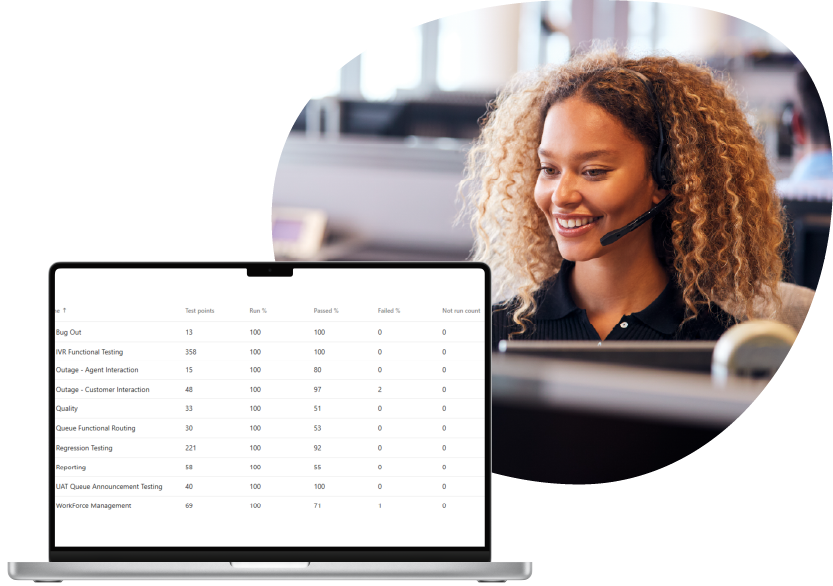
Resource Data designed and executed the testing framework used to validate the new contact center platform. The team developed a master test plan and created more than 2,000 test cases covering functional validation, user acceptance testing, and regression scenarios. These scripts tested customer and agent interactions across call flows, IVR routing, and system integrations.
UAT testing involved 12 subject matter experts from multiple operational departments, who executed scripts based on real service scenarios. Test results and defects were tracked in Azure DevOps, giving the project team a shared system to log issues, coordinate fixes with the implementation partner, and confirm resolutions through retesting. Resource Data also supported internal testers with guidance on executing scripts, estimating testing time, and documenting issues consistently, helping the organization validate the system before launch.
Features
Sustainable Testing Assets and Documentation
-
Test planning structure for organized testing cycles
A master test plan and Azure DevOps structure organized testing cycles, documented results, and created a consistent process for tracking and resolving issues.
-
More than 2,000 test cases for comprehensive system validation
Detailed scripts supported unit, functional testing, user acceptance, and regression testing scenarios across customer and agent interactions.
-
Cross-team testing for real operational workflows
Subject matter expert testers from five operational departments participated in testing to validate real service scenarios and system integrations.
-
Defect tracking and retesting for reliable issue resolution
A structured workflow allowed teams to log, prioritize, resolve, and retest issues as system configuration progressed.
-
Testing guidance for effective internal participation
Resource Data provided instructions and training to help internal teams execute test scripts consistently and document issues clearly.
-
Reusable regression test assets for future system updates
The test library created during the project will be reused to validate system updates, new call flows, and additional features as the contact center platform evolves.


- Jennifer Lober, Sr. Business Analyst, Resource DataWe worked closely with the client and Skybox every day, reviewing results, resolving defects, and retesting. That level of coordination made a huge difference in delivering a successful launch.

Results
A Stronger Start for Customer Service
The structured testing effort helped the utility launch its new contact center with operational confidence. By validating real service scenarios before deployment, the team reduced the risk of disruptions to critical customer interactions such as billing support, service requests, and outage reporting. Testing also prepared internal teams for the transition. Employees who participated in testing developed hands-on knowledge of the platform and were able to support colleagues as “super users” during rollout.
The documentation and testing assets created during the project now provide a repeatable process for validating future updates. This foundation helps the organization maintain reliable customer support, expand multilingual services, and handle a wide range of customer needs more consistently over time.

What's Next
Setting Up Better Customer Experiences
With test plans, scripts, and documentation now in place, the organization has a clear process for validating future updates to its contact center platform, such as new call flows, system updates, and expanded language support, including a Spanish IVR currently under development.
It also opens the door for new capabilities over time—such as chat, automation, or AI tools—as the utility company continues modernizing how it supports their customers.