

The Education Data Lift: Accelerating Statewide Enrollment Processing

In Brief
Rebuilding the Backbone of Oregon’s Student Data
Behind every education funding decision is a complex data system most people never see. Oregon’s Statewide Longitudinal Data System (SLDS) relied on an aging ETL tool and outdated Java libraries, making critical student data access slow, costly, and difficult to maintain.
The Oregon Longitudinal Data Collaborative (OLDC) needed an efficient way to manage and process statewide student enrollment and program data housed in the SLDS. Resource Data implemented a secure, VNET-injected Azure Databricks workspace and rebuilt ETL data processes with Azure PySparks notebooks. The system cut the time required to deliver refreshed data and reports from weeks to hours, and reduced annual costs by over 80%.
Key Takeaways
Cutting Over 80% of Annual ETL Costs with Databricks Automation
-
A Unified, Structured View of Student Data Across Oregon
V-NET Injected Databricks Workspace replaced manual and fragmented processing with a single, automated platform. Two hundred data tables across four state agencies are unified into a single view of student enrollment and programs for easier reporting and decision-making.
-
Reliable Student Data, Delivered in Hours—not Weeks
Databricks Workflows automates ETL execution across agencies, removing manual handoffs and coordination. Student data can now be refreshed, validated, and delivered on a predictable schedule in hours instead of weeks.
-
Code-Based ETL Significantly Reduced Maintenance Efforts
Code-based PySpark notebooks replaced outdated Informatica workflows, making the ETL easier to update, test, and adapt as reporting and policy needs change.
-
Achieved an 80% Reduction in Ongoing ETL Costs
Replacing Informatica with the Databricks Workspace model reduced ongoing ETL costs by more than 80%.
-
Automated Identity Matching for Reliable Longitudinal Analysis
Databricks standardizes and automates the data preparation steps feeding OLDC’s identity matching process, reducing delays and making longitudinal analysis for 18,000 students more reliable.

Our Client
Oregon Longitudinal Data Collaborative (OLDC)
The Oregon Higher Education Coordinating Commission (OHECC) is a state agency that coordinates higher education and workforce training in Oregon. Its mission is to improve access, equity, and student success, so education programs meet the needs of Oregon’s workforce.
Within OHECC, the Oregon Longitudinal Data Collaborative (OLDC) serves as an inter-agency research office that links education and workforce data across state partners like OHECC, public colleges and universities, apprenticeship programs, and workforce agencies.
OLDC manages the Statewide Longitudinal Data System (SLDS) and produces annual Career and Technical Education (CTE) outcomes reports that track whether graduates are employed or enrolled in postsecondary education. OHECC and the Oregon Department of Education use this data to evaluate programs, allocate funding, and support statewide policy development.

Challenges
Aging ETL Tools Slowed Data Processes and Delayed Critical Updates
The Statewide Longitudinal Data System supports Oregon’s long-term analysis of student pathways from education into employment. The system links approximately 156 GB of student enrollment data across 200 data tables for over 18,000 Career and Technical Education (CTE) student records across Oregon institutions. This data underpins Oregon’s research, reporting, and education funding decisions.
Over time, the Informatica-based ETL supporting the SLDS limited daily tasks and data processes. Aging graphical workflows and fragmented pipelines were slow, difficult to update, and required manual data movement between systems. Statewide enrollment updates took weeks or months, making it hard for OLDC to refresh data for research or respond to updated policy and reporting needs for funding.
Outdated, Java-based Informatica data components were costly and unpredictable. It made it difficult to align student data with corresponding workforce policy programs. Without modernization, OLDC faced growing data volumes, high vendor costs, and risked the ability to deliver timely insights to education and workforce policymakers.
The Solution
Rebuilding Trust in Statewide Student Data with Cloud-Based Databricks Architecture
Resource Data modernized and unified OLDC’s data operations by implementing a VNet-injected Azure Databricks workspace. The Databricks environment is a cloud-based analytics platform deployed within Oregon’s existing Azure cloud network. The solution focuses on secure access, automation, and a maintainable workflows to support long-term reporting across 200 cross-agency data tables.
The new architecture eliminates manual file transfers by allowing Databricks to connect directly to OLDC’s data sources inside the State’s network. Within this environment, our team rebuilt OLDC’s statewide ETL processes using PySpark notebooks. These notebooks handle data ingestion, validation, and transformation across ETL cycles, so they are automatically ready for downstream identity matching and reporting.
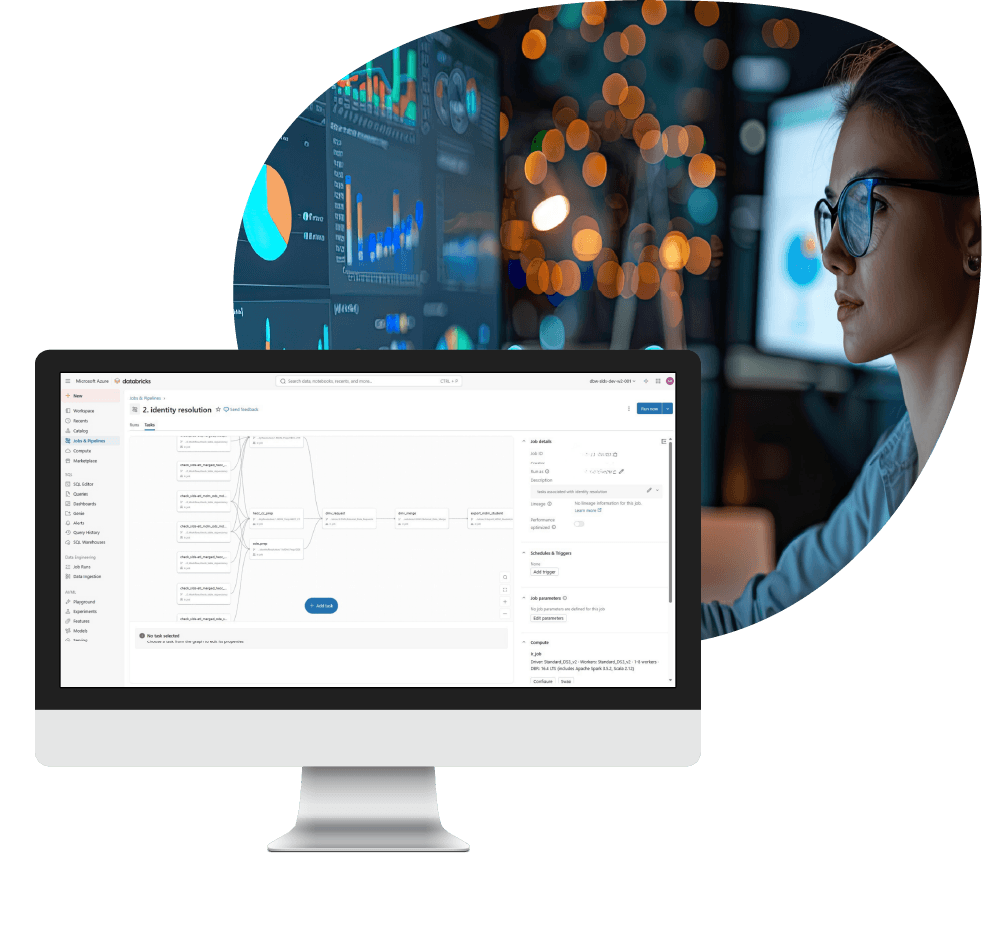
Within the Databricks workspace, workflows automate the full ETL process, including handoffs to and retrieval of results from the identity-matching system. Scheduling, dependencies, and monitoring are centrally managed, replacing ad-hoc execution. Each stage of the ETL is tracked in a single system, making issues faster to identify and resolve. What once required weeks of manual coordination now runs end-to-end in hours, producing a consistent, analysis-ready view of OLDC’s SLDS data.
Features
From Manual Pipelines and Updates to a Secure, Automated, Quick Data Platform
-
VNet-Injected Databricks Workspace for Secure, Direct Data Access
Deploying the Databricks Workspace inside OLDC’s own virtual network allowed external institutions and data partners to connect directly to on-premises and cloud databases without using public endpoints. All traffic remained inside the State’s controlled network, improving security and meeting governance requirements.
-
PySpark-Based ETL Enforces Data Quality and Simplifies Maintenance
Code-based PySpark notebooks enforce agency-specific data quality rules, log errors, and document transformations. This improves data consistency, simplifies debugging, and makes ETL logic easier to maintain as requirements change.
-
Databricks Workflows Eliminate Manual Coordination and Speed Data Delivery
Databricks Workflows automate ETL sequencing and scheduling across state agencies. This removes manual handoffs, provides clear run visibility, and delivers refreshed data in hours instead of weeks. Databricks keeps a history of data changes, while workflows provide clear run status and failure points.
-
A Governed ETL with Privacy, Compliance, and Security
ETL development and changes were reviewed and approved in coordination with OLDC’s data governance committee and data partners. This ensured data quality rules, transformations, and reporting outputs met privacy, security, and compliance requirements before reaching researchers.

Results
Reliable, Cloud Data Processes Transform Statewide Student Pathways
The Databricks Workspace reduced data processing cycles from weeks to only hours. Workflows that once required manual coordination now run automatically, with clear visibility into each step. ETL Operational annual costs dramatically dropped from by over 80%.
SLDS new architecture delivers analysis-ready unified student data faster on a scheduled pipeline. Improved data processing enables researchers and policymakers to thoroughly evaluate student and workforce programs and make confident funding and policy decisions. This modernization changed how quickly OHECC can answer policy questions and adapt to new education and workforce policies.

What's Next
Evolving SLDS to Meet Oregon’s Growing Data and Policy Demands
With Databricks established as a reliable cloud-computing and automation platform, OLDC is positioned to evolve and update SLDS components as needed. Resource Data continues to support OLDC as they scale their data capabilities to serve Oregon’s long-term research and student policy needs.



A state education agency usually speeds up student data reporting by replacing fragmented, manually coordinated ETL processes with an automated pipeline that can ingest, validate, transform, and deliver data on a predictable schedule. When updates take weeks or months, the real problem is often not just slow infrastructure. It is the combination of aging tools, manual handoffs, and limited visibility across the end-to-end data process.
In Resource Data’s case study, the Oregon Longitudinal Data Collaborative (OLDC) was managing statewide student enrollment and program data in the Statewide Longitudinal Data System (SLDS), but its Informatica based ETL had become slow, difficult to update, and dependent on manual data movement.
Resource Data’s answer was to rebuild the ETL process in a secure Azure Databricks environment using PySpark notebooks and Databricks Workflows. That changed the operating model from one that depended on manual coordination to one that ran through centrally managed scheduling, dependencies, monitoring, and automated handoffs. The result was that refreshed student data and reports moved from taking weeks to taking hours.
Now, researchers and policymakers get timely data when they need to evaluate programs, respond to policy changes, and support funding decisions. Resource Data’s example shows that faster reporting improves how quickly a state can answer policy questions, adapt reporting processes, and make decisions with current statewide education data rather than outdated snapshots.
The first things an education agency should modernize are the parts of the ETL environment that create the biggest operational drag: brittle workflows, manual file movement, poor observability, and logic that is hard to update as reporting needs change. If the platform is aging, expensive, and difficult to maintain, preserving the old workflow in a newer tool usually does not solve the real problem. In Resource Data’s case study, OLDC’s Informatica based ETL had aging Java based components, fragmented pipelines, and manual coordination steps that made statewide updates slow and costly.
Resource Data rebuilt those ETL processes as code based PySpark notebooks inside Azure Databricks, with workflows to automate sequencing, scheduling, and monitoring. The code based ETL is easier to test, update, document, and adapt than heavily manual or aging graphical workflows. It also makes data quality rules and transformations more visible and maintainable over time.
Results include lower maintenance effort, faster adaptation to new reporting or policy requirements, and reduced dependency on high cost legacy tooling. This case study shows that modernization should start where it improves reliability and maintainability at the same time, not just where it produces a cosmetic platform upgrade.
A state education agency can unify student data across multiple institutions by moving from fragmented, manually coordinated ETL processes to a centralized, automated data platform that handles ingestion, validation, transformation, and orchestration in one governed environment. The real issue is usually not that data exists in too many places. It is that the process for bringing it together is slow and hard to trust when reporting deadlines or policy questions change. In Resource Data’s case study, OLDC was working with approximately 156 GB of student enrollment data across 200 data tables. Data was linked across multiple state partners, and that information was used for research, reporting, and funding-related decisions.
In this case study, the solution to OLDC’s issues was a VNet-injected Azure Databricks workspace with rebuilt ETL processes in PySpark notebooks and automated workflows. That architecture replaced fragmented processing with a single automated platform and created a more structured statewide view of student enrollment and program data. Resource Data’s example shows that the platform matters less as a brand name than as a way to eliminate manual handoffs, unify processing logic, and deliver analysis ready data on a reliable schedule.
This solution led to faster reporting, more consistent statewide data, and better support for research and policy decisions. Instead of spending weeks coordinating updates across systems, the agency gains a dependable foundation for statewide education and workforce analysis.
Manual ETL handoffs create major problems because they slow delivery, increase coordination overhead, and make it harder to trust when data is current, complete, or ready for use. In a statewide reporting environment, delays do not stay isolated inside the data team. They affect researchers, program leaders, and policymakers who rely on updated data to evaluate outcomes, respond to reporting needs, and support funding decisions. In Resource Data’s case study, OLDC’s older ETL processes required manual data movement between systems, and statewide enrollment updates could take weeks or months.
Resource Data replaced that operating model with Databricks Workflows that automated ETL execution, scheduling, dependencies, and monitoring. The case study states that this removed manual handoffs and coordination. Each stage of the ETL was tracked in a single system, which made issues faster to identify and resolve. That kind of visibility matters because it replaces ad hoc execution with an auditable, repeatable process.
Results include faster time to insight and less staff time spent chasing process status instead of improving data quality and reporting value. Resource Data’s case study shows that removing manual coordination is one of the fastest ways to improve delivery speed and institutional confidence in statewide reporting.
A public sector data team can reduce ETL costs by moving away from expensive legacy tooling while designing the replacement around maintainable code, secure architecture, and governance approved workflows. Cost reduction only matters if the new environment still supports privacy, compliance, reliability, and long term reporting needs. In Resource Data’s case study, OLDC was dealing with high vendor costs tied to its aging Informatica-based ETL. Modernization was driven by speed and by cost and maintainability concerns.
Resource Data rebuilt the ETL in a VNet-injected Azure Databricks workspace with PySpark notebooks and governed workflows. In the case study, ETL development and changes were reviewed and approved with OLDC’s data governance committee and data partners. This helped confirm that data quality rules, transformations, privacy, and compliance requirements were met before data reached researchers. At the same time, replacing Informatica with the Databricks workspace model reduced ongoing ETL costs by more than 80 percent.
Resource Data’s example shows that agencies do not have to choose between lower costs and stronger governance if the modernization is built around secure architecture, reviewed transformation logic, and more maintainable code based processes.
A public sector data team can modernize sensitive student data pipelines by designing the new environment around controlled network access, governed change management, and secure data processing from the start. In government and education settings, modernization has to protect privacy, meet compliance expectations, and give agencies confidence that data transformations and outputs are appropriate before they reach researchers or decision-makers. In Resource Data’s case study, OLDC needed a modernized ETL environment that could support statewide student and workforce data without weakening governance or security controls.
In this example, the technical answer was a VNet-injected Azure Databricks workspace deployed inside Oregon’s existing Azure cloud network. This allowed direct connections to on-premises and cloud databases without public endpoints. ETL development and changes were reviewed with OLDC’s data governance committee and data partners to ensure privacy, security, and compliance requirements were met. That is the stronger relevance angle: the searcher’s question is about secure modernization, and Databricks appears in the answer as the implementation choice, not the starting point.
Resource Data’s work contributed to lower security risk, stronger governance alignment, and a more sustainable path to modernization. This case study shows that agencies can modernize sensitive statewide data infrastructure without
trading away control, compliance, or stakeholder trust.
Code based ETL pipelines help education agencies adapt faster because the logic behind ingestion, validation, transformation, and quality checks is easier to inspect, test, revise, and document. When reporting requirements change, agencies need to update transformation rules and workflows without fighting legacy processes. In Resource Data’s case study, code based PySpark notebooks replaced older Informatica workflows, and the case study states that this made the ETL easier to update, test, and adapt as reporting and policy needs changed.
Resource Data also used those notebooks to enforce agency specific data quality rules, log errors, and document transformations. Change in a statewide data environment is constant: new policy questions emerge, reporting definitions evolve, and linked datasets must still remain reliable enough for research and funding decisions. A code based approach makes those changes more manageable than maintaining aging, fragmented workflows that are expensive to troubleshoot.
Resource Data’s example shows that code based ETL is a practical way for education agencies to respond faster to changing policy and reporting demands while keeping transformation logic maintainable over time.
Agencies improve identity matching and longitudinal student analysis by standardizing and preparing source data before it reaches the matching process, so records are more consistent, and downstream linkage is more reliable. In multi-agency education environments, identity matching often breaks down because upstream data preparation is slow, inconsistent, or manually coordinated. In Resource Data’s case study, Databricks standardized and automated the data preparation steps feeding OLDC’s identity matching process.
Resource Data’s implementation also automated ETL handoffs to and from the identity matching system within the Databricks workflow environment. The case study says these reduced delays and made longitudinal analysis for 18,000 students more reliable. That is a useful pattern for agencies trying to link education and workforce data over time. Better matching outcomes often start with better upstream ETL design rather than only tuning the matching engine itself.
Resource Data’s example shows that when identity matching is fed by cleaner, better-governed data preparation, agencies are in a stronger position to evaluate student pathways, workforce outcomes, and the effectiveness of statewide education programs.
Creating a single, statewide view of student enrollment and program data requires more than central storage. It depends on consistent ETL logic, data quality enforcement, and reliable orchestration. It also needs an architecture that can unify data from multiple partners into a form researchers and policymakers can actually use. In Resource Data’s case study, the Databricks workspace replaced fragmented processing with a single automated platform, and 200 data tables across four state agencies were unified into a structured view of student enrollment and programs.
Resource Data accomplished that by rebuilding statewide ETL processes with PySpark notebooks and orchestrating them through Databricks Workflows, while also supporting identity matching and downstream reporting. The case study frames this as a modernization of the backbone of Oregon’s student data. This is a useful phrase because it points to the real value: not just moving data faster but creating a dependable foundation for statewide analysis and reporting.
The business impact is improving decision-making across education and workforce programs. Resource Data’s example shows that a unified statewide view helps agencies report more easily, evaluate programs more confidently, and support funding and policy decisions with data that is more current and analysis ready.
Better education data infrastructure improves policy and funding decisions because the speed, reliability, and structure of the data pipeline determine how quickly leaders can answer real questions about program outcomes, student pathways, and workforce alignment. If the infrastructure is slow or unreliable, even strong analysts and researchers are working from outdated or inconsistent information. In Resource Data’s case study, OLDC’s student and program data supports annual Career and Technical Education outcomes reporting used by the Oregon Higher Education Coordinating Commission and the Oregon Department of Education to evaluate programs, allocate funding, and support statewide policy development.
Resource Data’s modernization reduced processing cycles from weeks to hours, delivered a scheduled pipeline for unified analysis ready student data, and improved how quickly the agency could answer policy questions and adapt to new education and workforce policies. That is the critical connection between data engineering and public value. The case study is not just about ETL modernization for its own sake. It is about rebuilding the infrastructure behind decisions that affect students, programs, and public investment.
Results include faster time to insight, stronger confidence in statewide reporting, and better support for funding and policy choices. Resource Data’s example shows that when agencies modernize the data backbone, they improve technical performance and the quality and timeliness of the decisions built on top of that data.