




Alaska Energy Hub: A GIS Solution helping fund critical energy projects
Back to InsightsIn Brief
Resource Data developed the Alaska Energy Hub, a public-facing ArcGIS platform, to help Alaska Municipal League connect communities with resources and funding for energy projects. In its first year, the platform received nearly 10,000 visitors and 25 project submissions, helping communities’ advance energy initiatives.
Background
The Alaska Municipal League (AML) is a nonprofit, nonpartisan membership organization of 165 Alaska cities, boroughs, and unified municipalities. AML represents over 97 percent of Alaska’s residents and is responsible for fielding and progressing community projects competing for federal funding.
Resource Data worked with AML on an AK DOT&PF project, creating the Alaska Transportation Funding Opportunity Hub (Transportation Hub) in 2022 to support the identification and progression of infrastructure project applications for grant funding. They thought the State of Alaska could benefit from a similar hub for energy-related projects.
Need
AML was determined to find ways to connect their members with resources and agencies that provide funding and technical assistance to progress all types of energy projects. They liked the technology and user interface of the Transportation Hub we built but wanted a simpler version of it—a public-facing website with access to the project intake survey that collects information about the prospective projects.

Solution
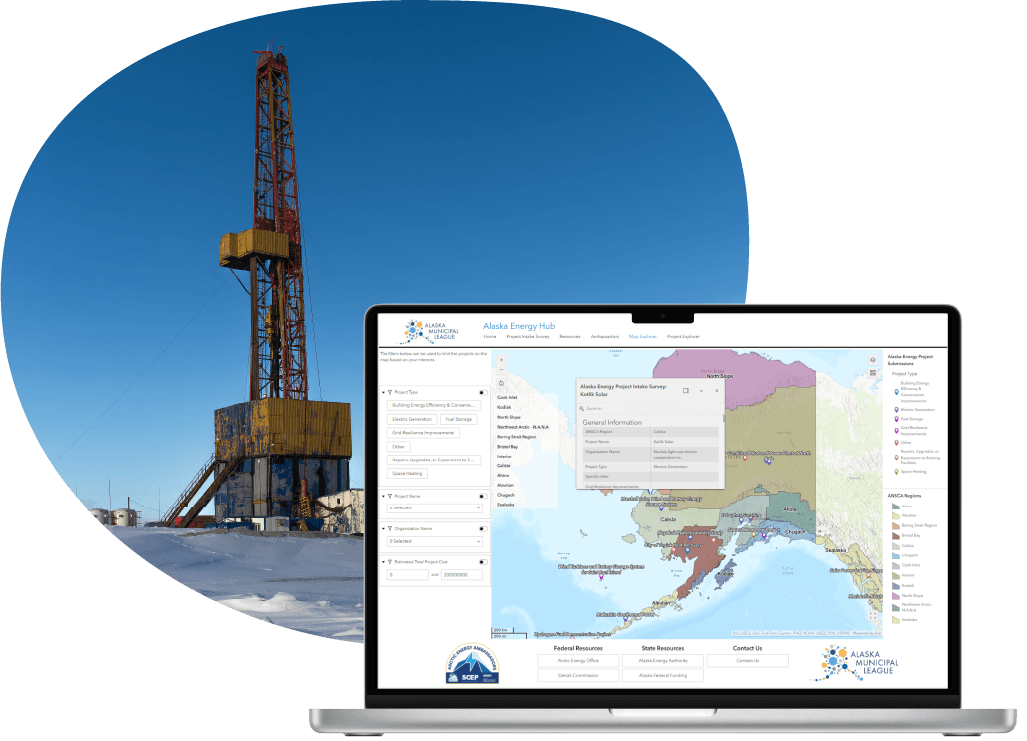
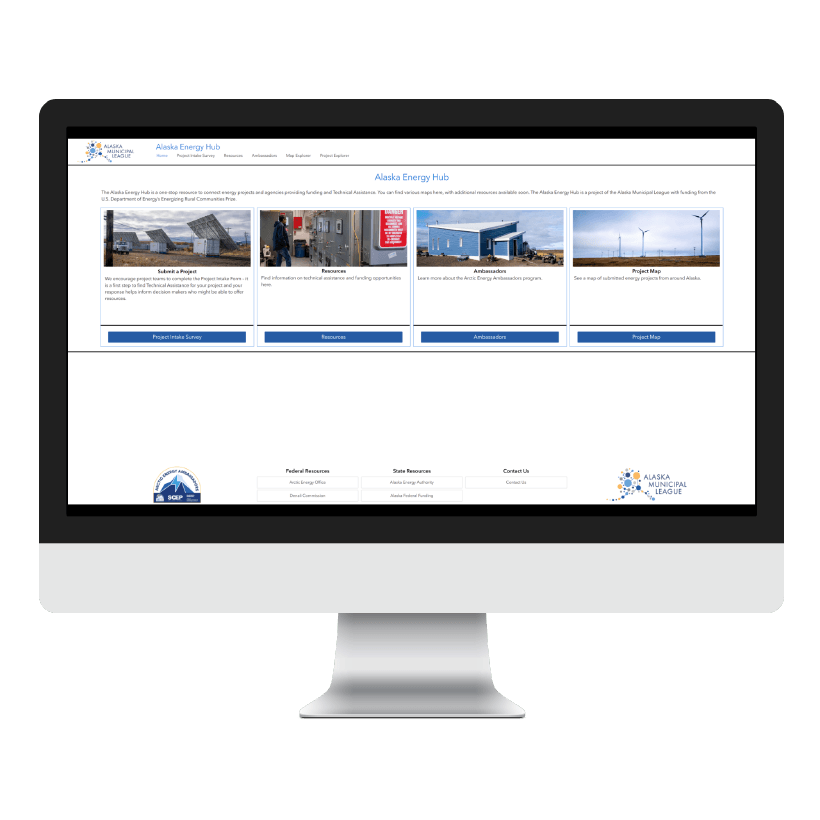
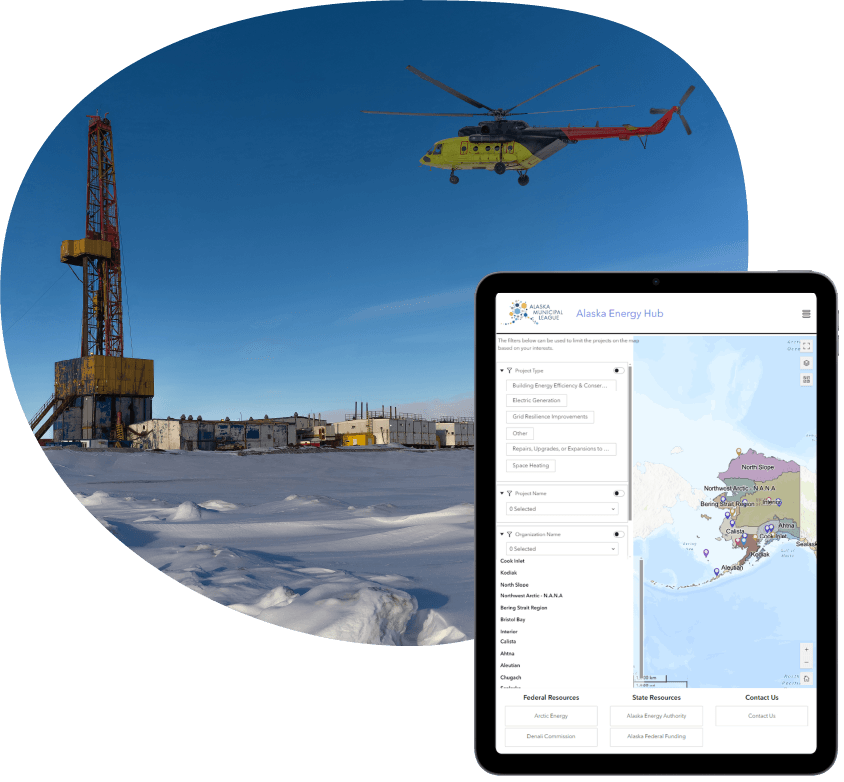
Resource Data created the Alaska Energy Hub, an ArcGIS Online solution that provides communities access to many useful energy project assistance resources. The Energy Hub features
- Public-facing Experience Builder website
- Survey123 survey for project submissions
- Interactive web applications
- Project-data querying interface
- Access to external energy project resources
- Administrative backend for AML staff to review, edit, and manage energy project locations and details efficiently
- Automated emails using Power Automate ArcGIS Online connectors triggered by project-concept submissions
Because of the Alaska Energy Hub that Resource Data developed, the Energy Ambassadors and community leaders now have a really easy path to submitting projects.
Nils Andreassen, Executive Director, Alaska Municipal League
As part of this effort, AML and their partners also spearheaded the Arctic Energy Ambassadors program. The program selected ambassadors from 12 regions within Alaska to provide a local champion to connect with stakeholders and develop regional and statewide projects.
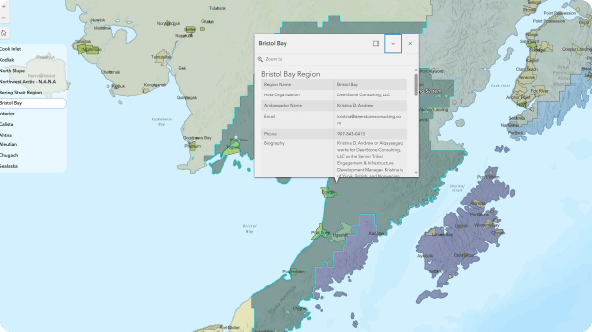
Resource Data supported this effort by creating an Arctic Energy Ambassador Application and generated reports for each applicant to support internal review and selection. Once the ambassadors were selected, we updated the public-facing Energy Hub to introduce the ambassadors and provide contact information for communities seeking technical assistance.
Results
The Alaska Energy Hub offers AML members access to a one-stop resource that makes it easy for Energy Ambassadors and community leaders to submit projects. The website received nearly 10,000 views within the first year, and the communities have submitted 25 energy project concepts. Plus, its administrative functions help staff manage project details efficiently.




Case Study FAQ
A statewide municipal organization can make that process easier by creating a public-facing place where communities can discover resources; understand where to start; and submit project concepts without having to go through disconnected agencies, websites, and contacts on their own. Some of the challenges in getting energy funding are figuring out which programs, technical assistance pathways, and submission processes are relevant to a community’s project.
That is more important in a state like Alaska, where communities are geographically dispersed, and project development capacity varies widely. If local leaders have to piece together the process themselves, worthwhile projects can stall before they are even described clearly enough to seek support. A centralized hub lowers the friction at the earliest and most important stage: turning local energy needs into fundable project concepts.
In Resource Data’s case study, the Alaska Municipal League (AML) wanted to connect member communities with resources and agencies that provide funding and technical assistance for many kinds of energy projects. Resource Data built the Alaska Energy Hub as a public-facing ArcGIS Online solution that gives communities access to energy project resources and a straightforward project intake path. This case study demonstrates that a one-stop platform can reduce confusion and help more communities move from need identification to action. Results include better project visibility, easier intake, and a clearer route toward funding and technical support.
Communities often need more than a funding list because energy projects rarely move forward based on funding awareness alone. They also need help framing project concepts, connecting with the right support network, understanding technical assistance options, and getting their ideas into a form that decision-makers can evaluate. A list of programs may be useful, but it does not solve the workflow problem of how a community turns an idea into a viable project opportunity.
This is especially true for smaller or remote communities that may not have dedicated energy planning staff. Even when funding programs exist, the path from local needs to project submission can still feel unclear. A better system gives communities information and a mechanism for engagement so they can move from browsing to submitting.
In Resource Data’s case study, AML wanted a simpler public-facing website that provided access to energy resources and linked directly to the project intake survey that collects information about prospective projects. The Alaska Energy Hub combines external energy resources, interactive web applications, and a Survey123 intake process on one platform. This case study shows that communities need information access and a practical entry point into the project pipeline.
It takes a platform that serves both audiences at once: a simple, intuitive public experience for community users and a structured administrative backend for the staff responsible for reviewing, editing, and managing project details. Public portals often fail when they focus only on the front-end experience and ignore the internal workflow needed to keep submissions usable, current, and actionable.
That internal side matters because intake volume, incomplete submissions, follow-up communication, and project tracking can become a burden if staff are still managing everything manually. A well-designed system connects public intake to a manageable backend so that staff can review submissions efficiently, and communities get a more responsive process.
In Resource Data’s case study, the Alaska Energy Hub included a public-facing Experience Builder website, a Survey123 project submission form, and an administrative backend for AML staff to review, edit, and manage energy project locations and details efficiently. The solution also used automated emails triggered by project submissions through Power Automate ArcGIS Online connectors. In this case study, it’s illustrated that a successful project portal has to support internal operations just as much as public usability. The results include a smoother intake management, less manual follow-up, and a more sustainable workflow for staff.
A GIS-based hub helps by creating a shared, visible place where communities, regional champions, and statewide organizations can connect around the same project information and resource landscape. Energy project development depends on relationships as much as technology, especially in geographically large regions where local context matters. A hub can make those relationships more actionable by giving everyone a common entry point into the process.
That is particularly useful when a program relies on regional representatives or trusted intermediaries to help communities navigate technical assistance and project development. When those local champions are visible and connected to the platform itself, the hub becomes part of the support network communities can use to move ideas forward.
In Resource Data’s case study, AML and its partners launched the Arctic Energy Ambassadors program, which selected ambassadors from 12 Alaska regions to act as local champions for stakeholder connection and project development. Resource Data supported that work by creating an ambassador application, generating internal review reports, and then updating the public Energy Hub to introduce the selected ambassadors and provide contact information for communities seeking assistance. In this project, digital platforms helped strengthen human support networks instead of replacing them. The benefits were better regional coordination, easier access to technical assistance, and stronger community engagement in energy planning.
The strongest early signs are a combination of usage, meaningful submissions, and improved staff’s ability to manage project information. Website traffic can show awareness, but it does not prove that communities are using the tool to move projects forward. What matters more is whether the platform helps turn interest into submitted concepts and whether the managing organization can work with those submissions more effectively.
That is why early success should be measured through public engagement and operational outcomes. A good hub should attract visitors, but it should also generate usable project concepts, improve staff efficiency, and create a clearer path from community idea to organized follow-up.
In Resource Data’s case study, the Alaska Energy Hub received nearly 10,000 views in its first year, and communities submitted 25 energy project concepts through the platform. The case study also notes that the administrative features helped AML staff manage project details efficiently. This example shows that a public-facing GIS hub is delivering value when it creates public momentum and internal workflow improvement.